 EN
EN
 ES
ES

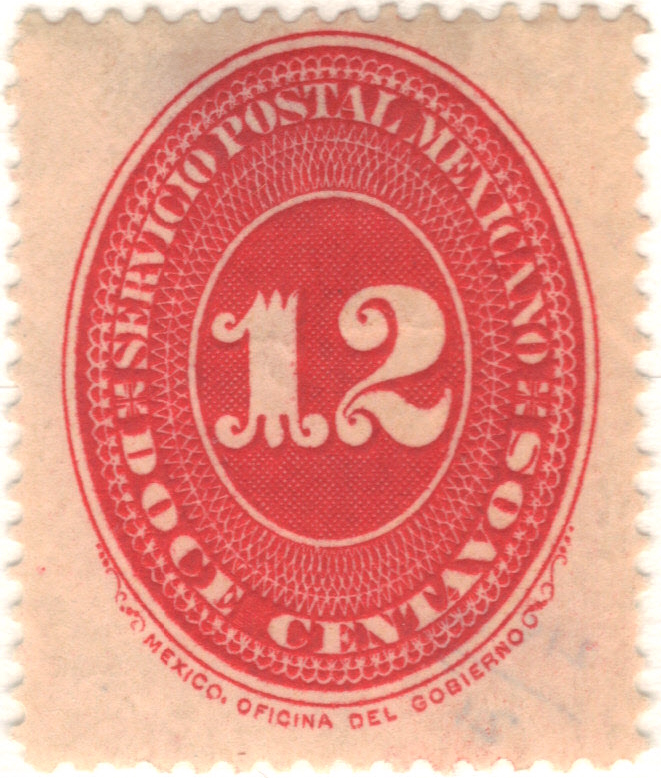
The Large Numerals of Mexico 1886-1895
This article was originally published in MEPSI's journal, Mexicana, in January 2013.
There is very little in the literature written about the Large Numerals. Although a number of very short articles exist, none of them are comprehensive enough to cover the whole issue. Most contain highly specialized research about very narrow areas like the size of the design, the perforations, the colors or the positions of the green-lined ledger paper issue.[1] Other than the excellent chapter in Follansbee’s A Catalogue of the Stamps of Mexico 1856-1910, which is indeed comprehensive, and the very informative chapter 19 in Three Centuries of Philately in Mexico (Amexfil 2006) dedicated to this issue I have not come across much dealing with postal history or what is rare in the issue.
Here are some notes with the information I have collected through the years, which includes notes in the collection of the late Jacob “Jay” Bard of Chicago, a veteran MEPSI member who was the specialist in Medallions and Large Numerals for at least 50 years. He was an avid collector who acquired much of what was available of these issues during his long life and was hard to beat in auction. Examining his collection of Numerals was an exceptional opportunity for me to learn what is rare and what probably does not exist in this issue.
Two Issues Co-Existing, in Parallel
This issue was valid for postage from July 1, 1886, to April 1, 1895. It co-existed with the Hidalgo Medallions until that stock ran out. Although legal, Medallions covers used after 1886 are less common. Only once before had a Mexican postmaster allowed two stamp issues to co-exist when Mexico joined the UPU. At that time, the 1874 issue was in place along with the Juarez issue which was for foreign mail. However, later on, the Juarez issue was allowed to be used to pay domestic mail.
Design and Production
Proofs
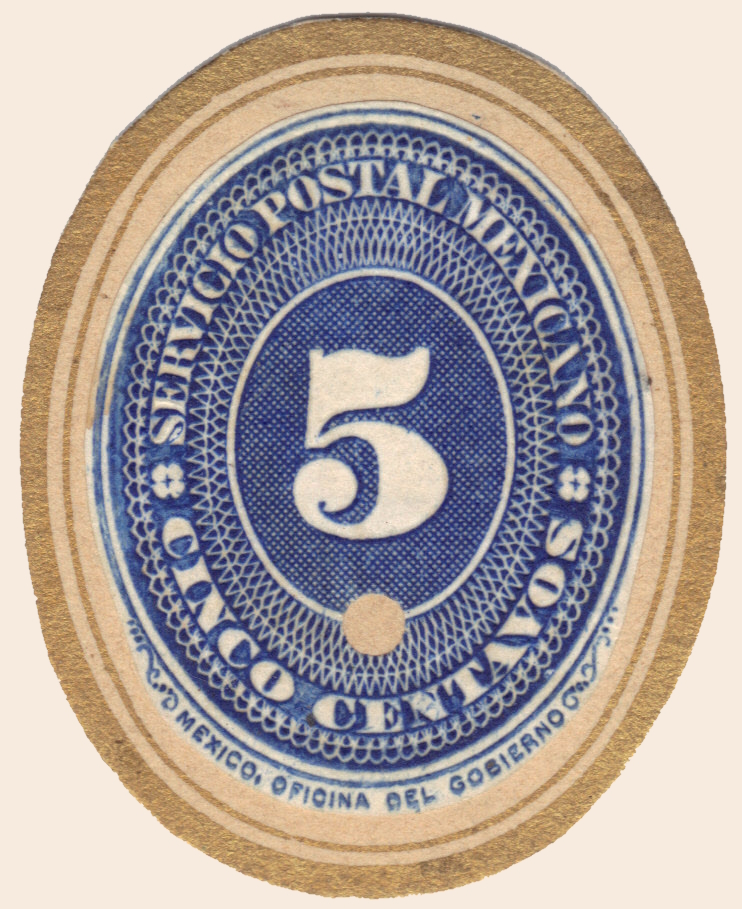
Originally, the issue was designed to include 50c, 1 peso and 2 peso values which were part of the set of proofs. Since there were plenty of available stock of those 3 values from the Medallion issue, they were ultimately deemed unnecessary and were not issued. Proofs of the unissued values are particularly scarce.
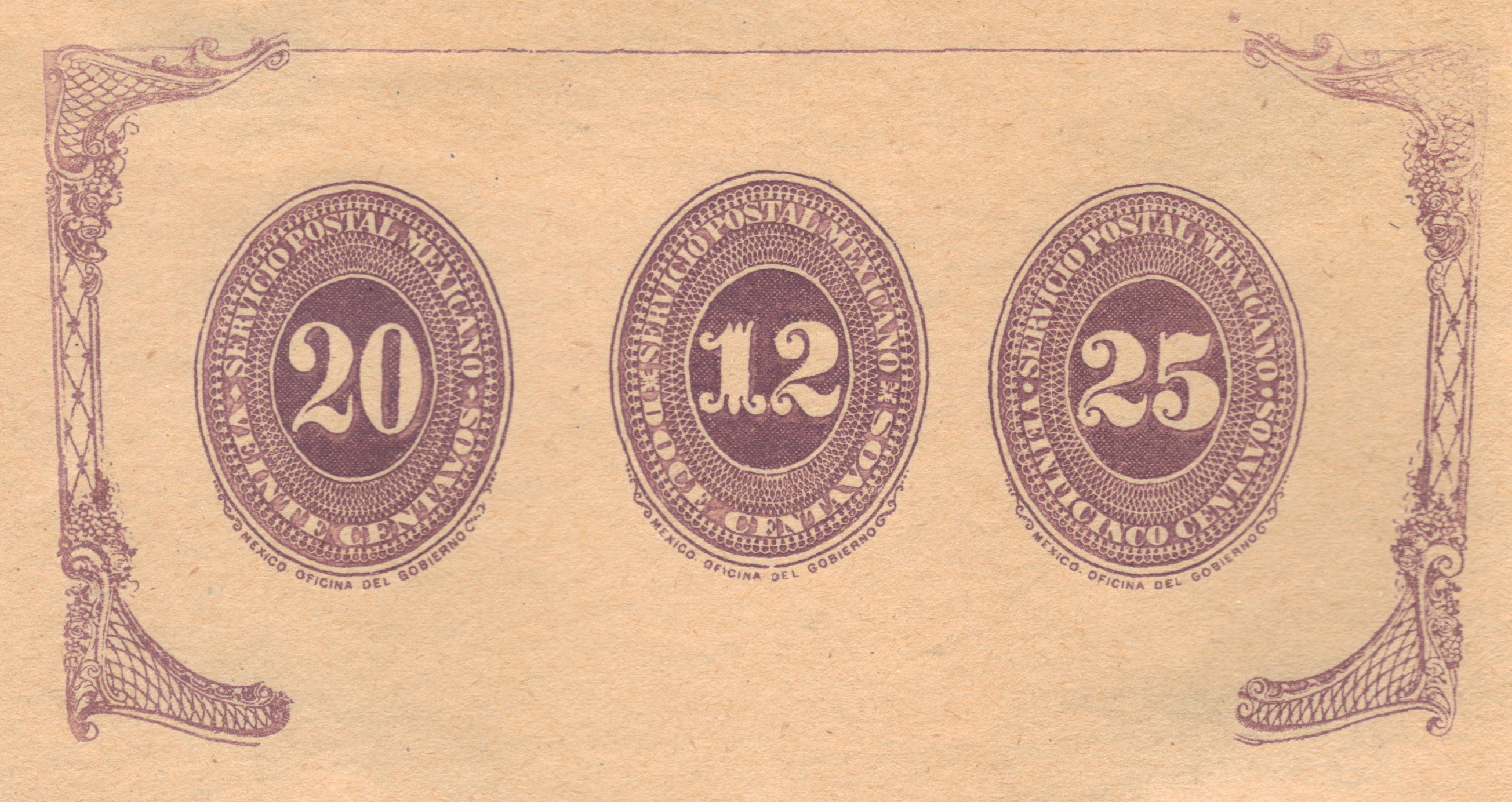
One of the most beautiful proofs, probably unique, is a composite of the 12c, 20c and 25c in lilac (fig#2).
The design is engraved with exquisite detail only apparent with magnification (fig#3).
Colors
The 1c green, 2c carmine and 5c blue were printed in the UPU authorized colors for those denominations. They are known in different shades: 1c green and yellowish green; 2c deep red, carmine lake and brownish carmine; 5c blue, dull blue, ultramarine, slate blue and bluish green.
The rest of the values were printed first in lilac and then in shades of red and orange. In April 1961 an avid researcher, Dr. Abner I. Weisman of the Collector’s Club of New York exhibited a study of the changes in color of the 10c. He attributed the shades to the availability of pigments at different times in the issue. His study was based on a selection of stamps with clear date cancels. The shades happened in the following order: lilac (1886), brown lilac (1887 only for 10c), red (1888), vermillion (1889-1895) and orange (1891-1892). This research is probably applicable to all the values except 1c, 2c and 5c.
Papers
Very few people can actually distinguish the small differences in paper fabrications. Jay Bard identified the following types:
- Unwatermarked: horizontal wove (1886-87), soft vertical wove (1888-90), wood pulp horizontal grain (1886 and 1890-91)
- Watermarked: ledger green lines (1887), porous horizontal wove (1891-95) and vertical hard wove (1892-95).
A very comprehensive discussion of paper types is in Nicholas Follansbee’s catalogue, p.108.
Specimens
Some overprinted specimens exist. All are scarce. The first group is in the 1886 colors (lilac for most values) with a COLECCION (collection) overprint. Mexico collectors have believed for years that these stamps were for collectors. However my colleague Jaime Benavides correctly pointed out to me that these stamps may have been printed for the collection of the post office. They could have been used for UPU distribution as well. Either scenario may explain why these stamps are so uncommon.
The second group is in the 1891-92 colors (orange for most values) with SPECIMEN overprint. This is odd as these stamps were printed in Mexico and the correct word should be “ESPÉCIMEN” or “PRUEBA.” Which leads me to believe these may have been intended for UPU purposes to be sent abroad.
Perforations
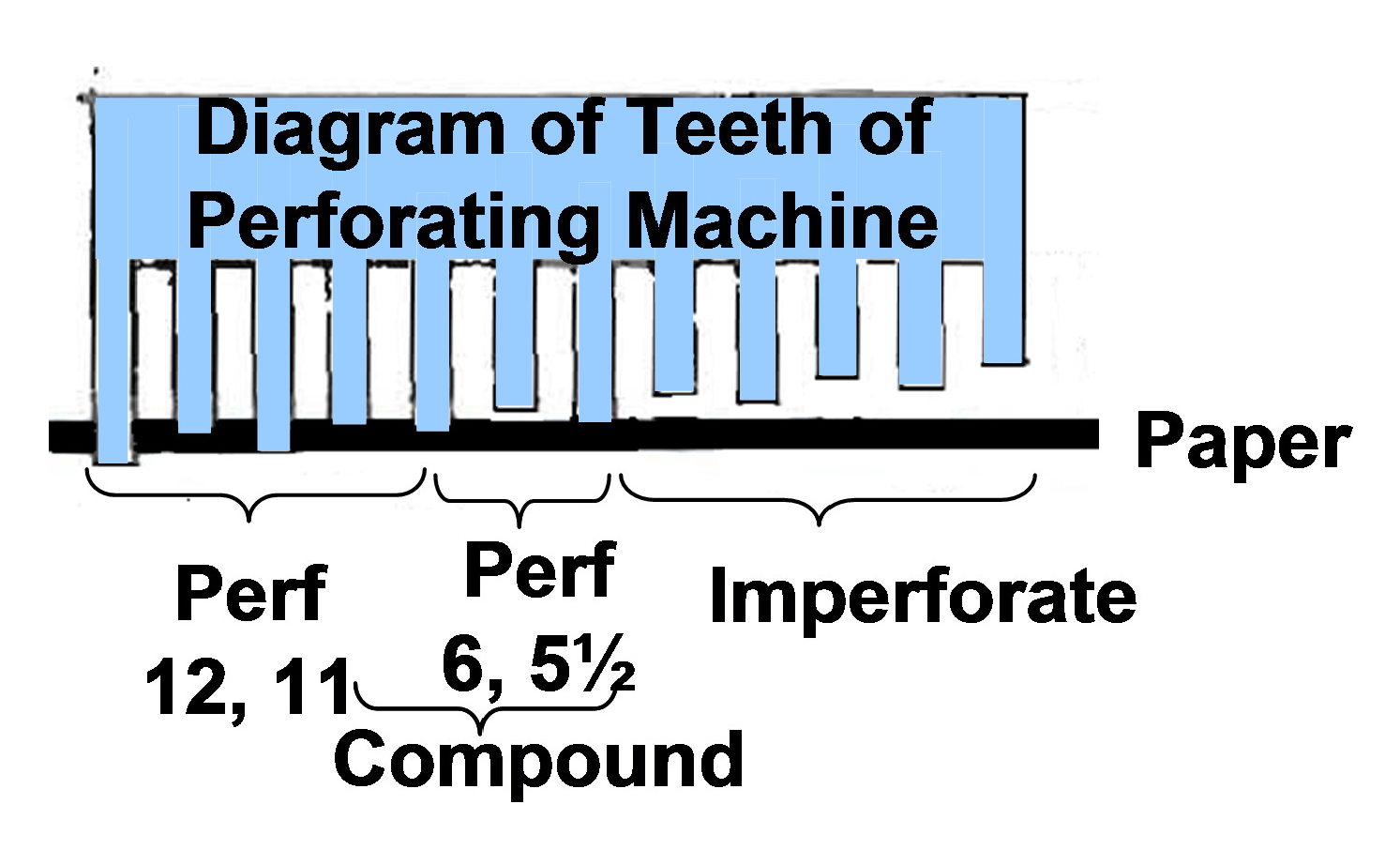
Perforation gauges were primarily 12 and to a lesser amount 11. At some point some pins which were required to perforate the sheets broke. To quickly solve the problem the good pins were redistributed along the equipment, skipping one pin at a time, creating the perfs 6. Nick Follansbee thinks that perforations 5½ have a different origin, he told me: “The perf 11 pins had flat ends and were of graduated and alternating lengths. The shorter pins did not always penetrate the entire stack of sheets.”
Similarly, the perforation errors (imperforate between, imperforate and mixed perfs 6 x 12) occurred when some of the pins failed to reach the individual sheets of paper piled up at the bottom. All these were accidental and are rare. A drawing of how these errors happened is in fig #4.[2] As for the combinations 11 x 5½, it is likely the same fabrication problems occurred.
All these varieties are uncommon and in some values unique. Unfortunately, some forgers have created versions of these varieties from large margin stamps. Perforation errors that do not align with the corresponding perforation on the other side of the stamp are always suspect, although not always fake. A case in point is one of the 2 existing complete sheets of the 5c ledger lines. It shows that due to faulty fabrication, perforations do not always align side to side. However in the one recorded 10c sheet ledger lines, all the perforations do match, including the few combination perforations in it. So, in addition, the expertiser has to look at the diameter and shape of the perforations to be sure combination perfs are genuine.
It is best to seek an expertizing certificate when pursuing such perforation varieties. It is always best to acquire multiples which are far more difficult to fake.
Plate Numbers
Only two plate numbers are known in this issue, plates 1 and 3 on the 10c value. The best such item I have seen is one stamp on cover with a very clear number 3 on the lower right side of the stamp.
District Overprints
As an anti-theft device, early issues of Mexico contain overprints with the name of a specific district. They were mandatory in all the early classic issues but were discontinued in 1883. However, habits die hard and at least 2 district overprints from this issue are known although very seldom found: Maravatio and Guadalajara. A cover from Tajimaroa in the district Maravatio shows that the postmaster in that small town was using the old overprint as late as March 1890, although such overprints have not been found anywhere else in that district. The Guadalajara overprint is known from at least one single used stamp.
Rates
Each of the denominations was created to be used for a specific rate except the peso denominations which were meant for large parcels. Solo covers exist for all values, although some are very rare. Except for the registration flat fee, all basic letter rates were based on multiples of weight of 15 grams. The most common were:
Basic Rates
| Circulars and printed matter Domestic and USA | 1c |
| Printed matter to Europe | 2c |
| Domestic | 10c |
| Official use | 3c |
| USA, Guatemala, Canada | 5c |
| Other countries within UPU | 10c |
| Other countries in subsidized ships[3] | |
| - Letters | 5c |
| - Printed matter | 1c |
Registered Rates
All registered rates had a flat fee (25c domestic, 10c overseas) additionally to the above rates, so the minimum base rates were
| Domestic | 35c |
| USA, Guatemala, Canada | 15c |
| Other countries | 20c |
| Official domestic use | 28c |
| AR Return receipt, add | 5c |
The Three Different Numerals Issues
Nicholas Follansbee suggests that the best way to study the Numerals is by the 3 main types of paper used.[4] These should be considered separate issues:- Unwatermarked paper 1886-1891. Most values issued in lilac and then in red. Stamps are scarcer than the watermarked issue.
- Green Lined Ledger paper 1887-1888. Printed as an emergency on ledger paper with green lines on both sides. Although some mistakenly name this issue “blue lines”, lines are actually green. All values are difficult to find particularly on cover because this issue is only known from covers dated in late 1887 and the first part of 1888. Combined perforations are scarce and have been extensively forged. Details about this issue can be found in the articles by Abraham Odfjell and by H.J. Almquist in Mexicana.[1]
- Watermarked CORREOS E U M paper 1891-1895. Most values issued in vermillion and orange. This issue is the most common of the three.
THE JEWELS
Stamps and covers of this issue are abundant, so collecting it is a particularly rewarding hunt, especially if you know which items are rare or harder to find. Here is my list of the 16 “jewels” which provide the thrill of the hunt for this issue, and which I have not mentioned elsewhere:
- Well centered stamps, as most in this issue are notably off-center.
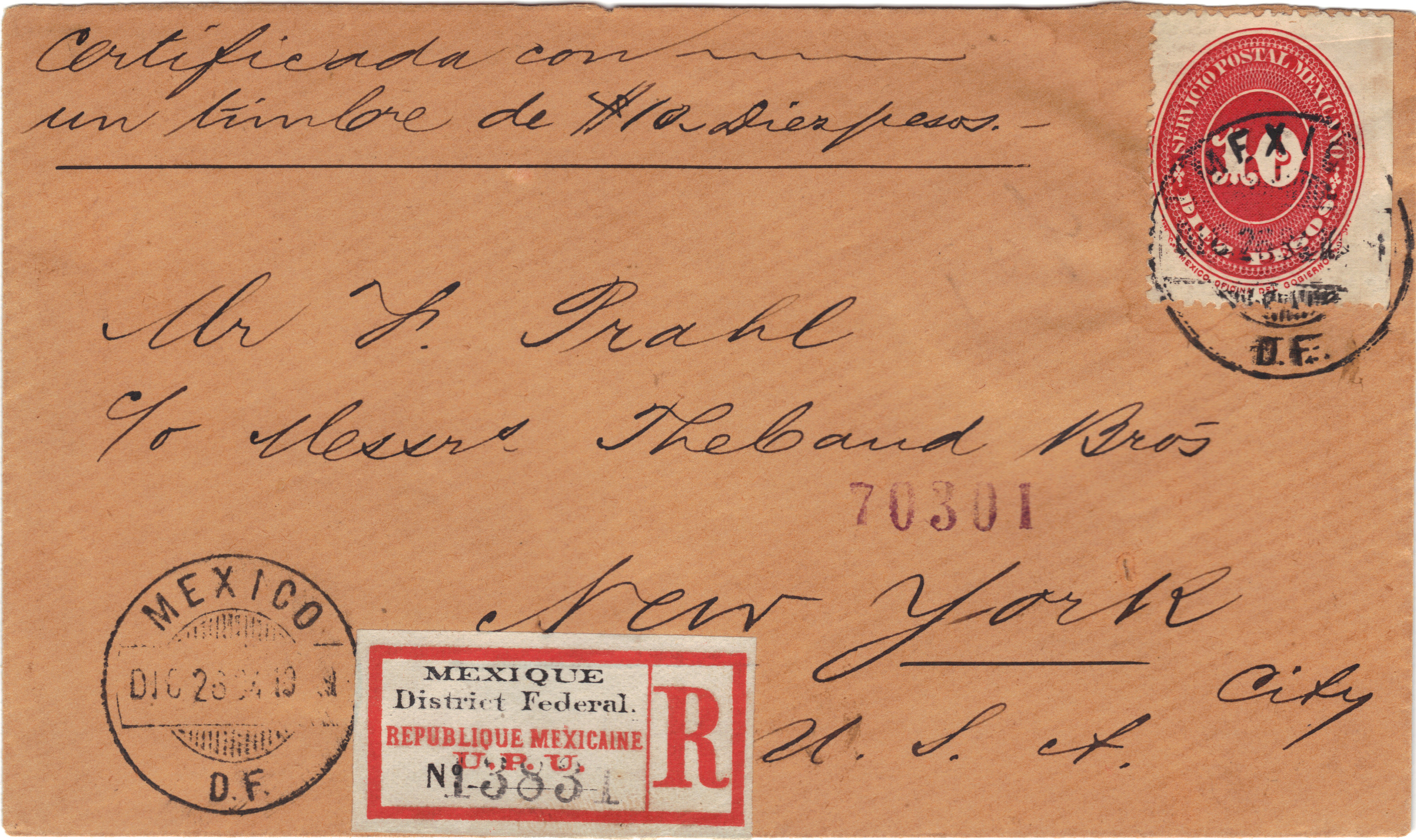
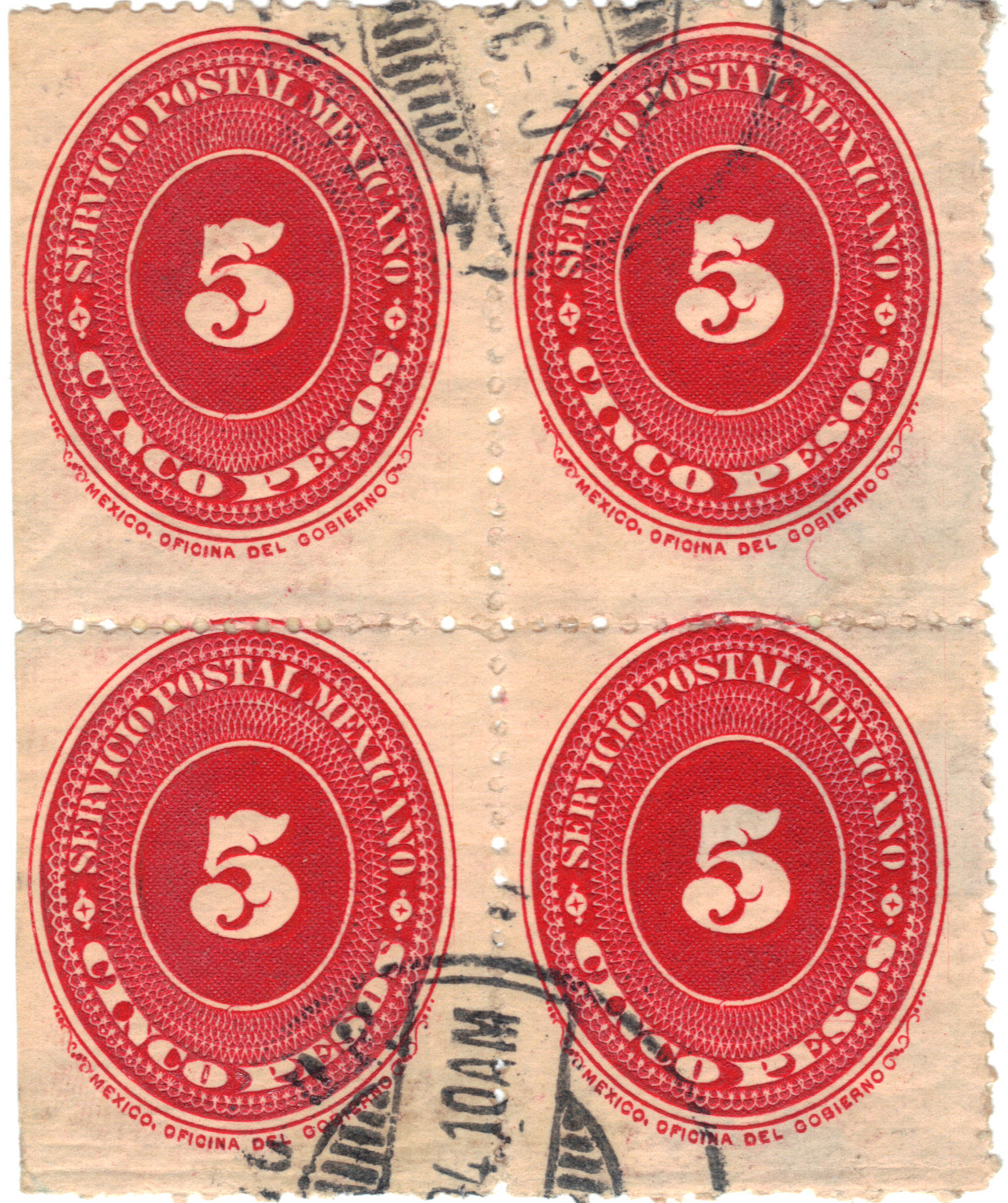
- Peso values. According to Nick Follansbee, only 300 stamps were issued for the 5 and the 10 pesos. At least one registered cover to New York exists of each denomination, and both are philatelic (fig#5). I know of only one multiple, a block of four of 5 pesos cancelled (fig#6), although a pair of 10 pesos is reported in the literature but may no longer exist as such. Although high values are watermarked, there is at least one 5 pesos that is not because it escaped the watermark.
- Solo usages on cover of the 2c, 3c, 4c, 6c, 12c values. These make very uncommon or esoteric rates. They all exist.
- Most combinations and multiples on cover of the stamps above as most Numerals covers bear 5c and 10c stamps to make up the basic rates.
- Rates to Europe in subsidized ships. They are: 5c rate for letters and 1c for printed matter, instead of the 10c and 2c in regular ships. Jay Bard only had 3 such items out of hundreds of maritime covers in his collection.
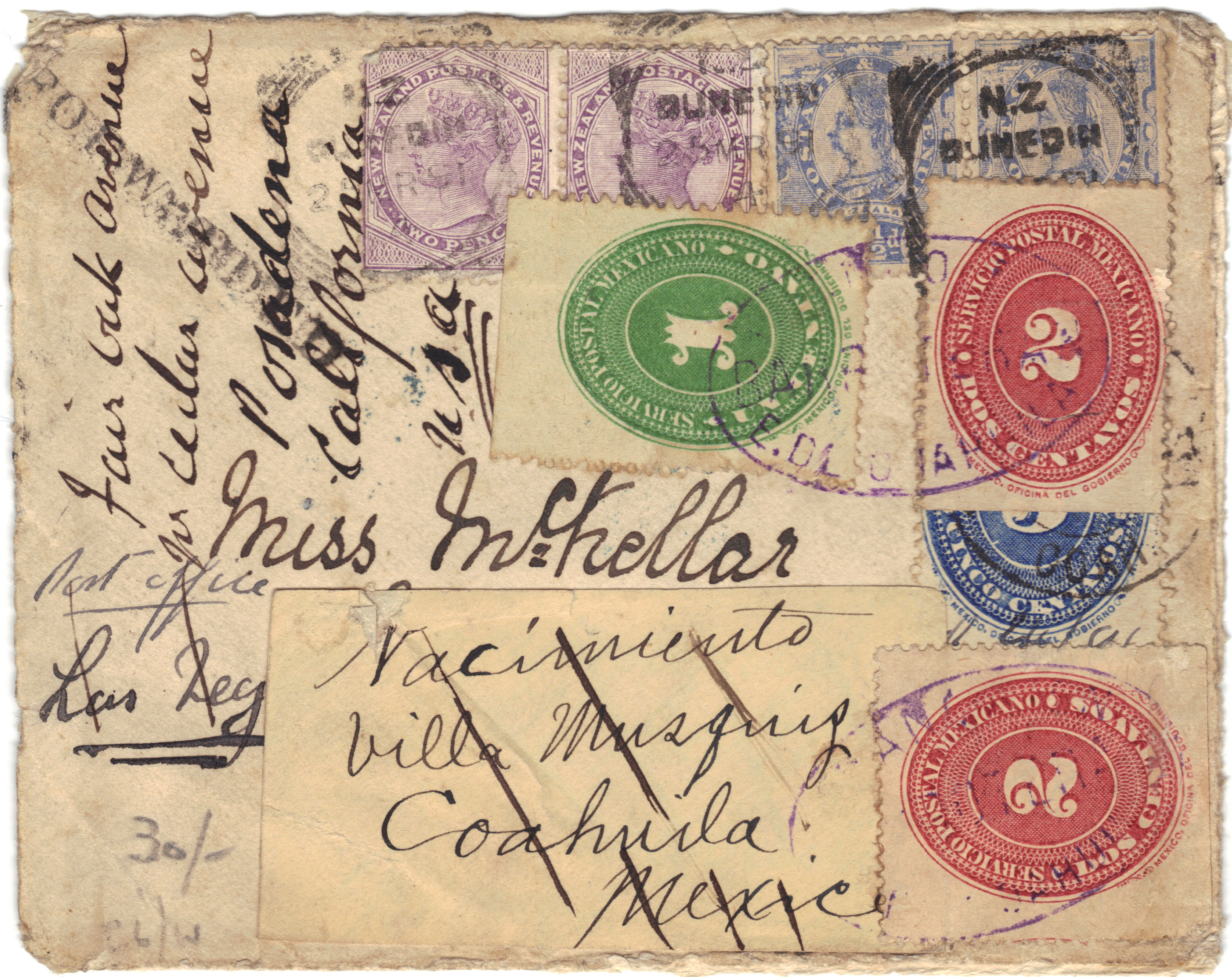
- Postage due and combination covers with stamps from other countries. One of the most interesting is a letter from New Zealand to Muzquis, Coahuila, later on forwarded to Pasadena, USA (fig #7). This letter is dated March 25, 1891. On arrival to Muzquis someone in that location paid 5c due. Then the letter was forwarded to the addressee in Pasadena, and 5c more were added with Mexican postage.
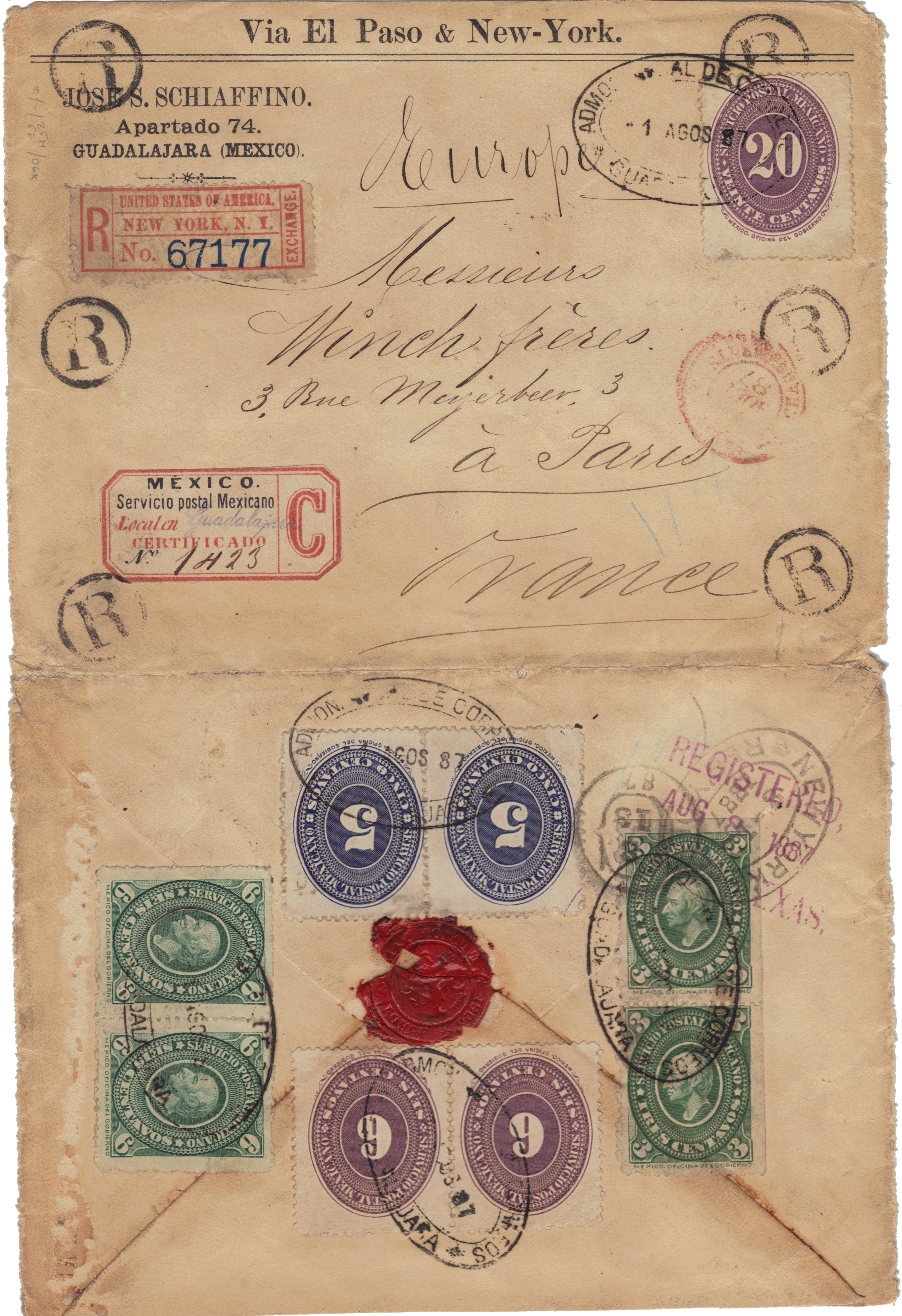
- Covers with the 12c, 20c and 25c lilac. Only one with the 20c is recorded, which is registered and not philatelic (fig#8). Jay Bard never had one of the latter, so this fine cover is most likely unique.
- 20c red UPU identity booklets. These were intended for people to pick up their mail from post offices around the world. They have translations in many languages at the back of the booklet. I have never seen or heard about a used one and none were in the Jay Bard collection, so Mexican ones probably do not exist.
- Covers with stamps from the the green lines ledger paper issue, and in particular with the 1c or the 10c red. Just a handful of the latter are recorded and Jay Bard had none of the 1c.
- Combined perforations of the ledger green lines issue. Unfortunately there are many fakes.
- Non-philatelic bisects. Genuine examples exist of the 2c, 4c and 5c.
- At least one cover exists with the 10c Brown without ledger lines (fig #9). This stamp was used briefly.
- Some of the perforation oddities, like the unwatermarked 3c perf 6, of which there is at least one cover addressed to San Francisco, CA (fig #10.). The one shown was believed genuine by Jay Bard and bears two 1c stamps on the back to correctly pay for the single rate to USA.
- There are some spectacular registered covers in this issue. One of the iconic ones was sent from Mazatlan to Mexico, but the addressee was not found. The cover has the original return receipt still pasted on the back (fig#11).
- Cancellations from small towns are uncommon. An example from Barras de Piaxtla in (fig#12) illustrates this point. This fishing village on the Pacific Coast had a population of only 450 people in 2011. Just imagine how small it was in 1891 when this cover originated!
- Used 10c advertising private postal stationery covers. Maybe 10 exist. They are discussed at the end of this article.
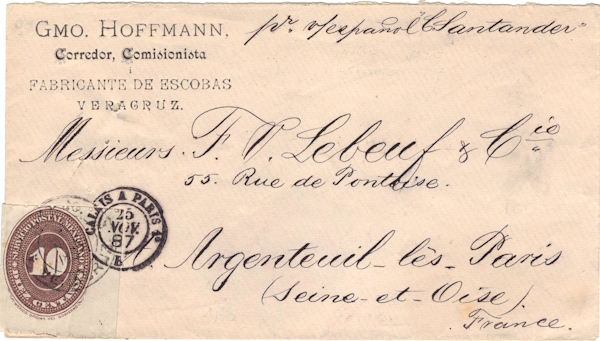
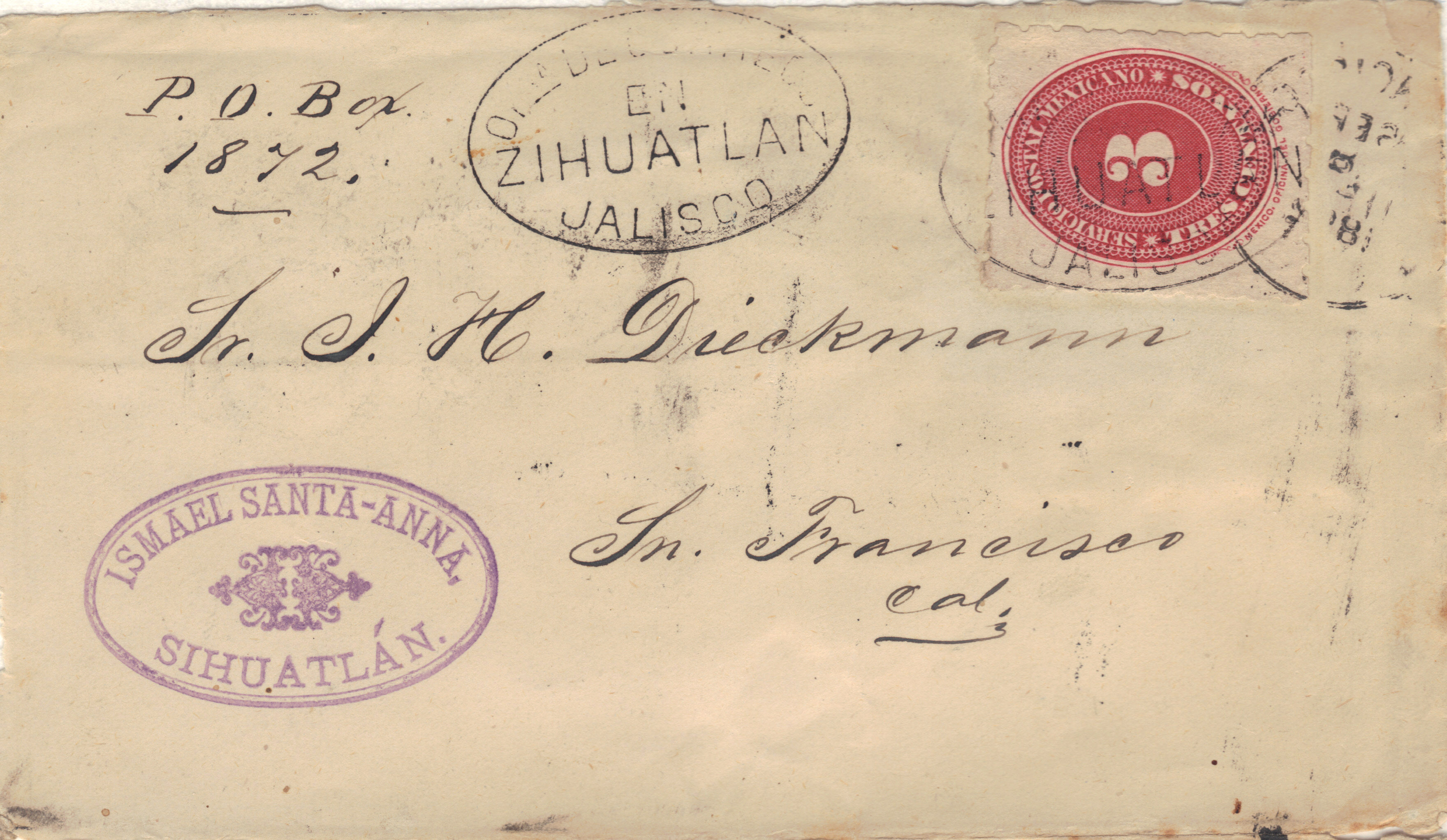
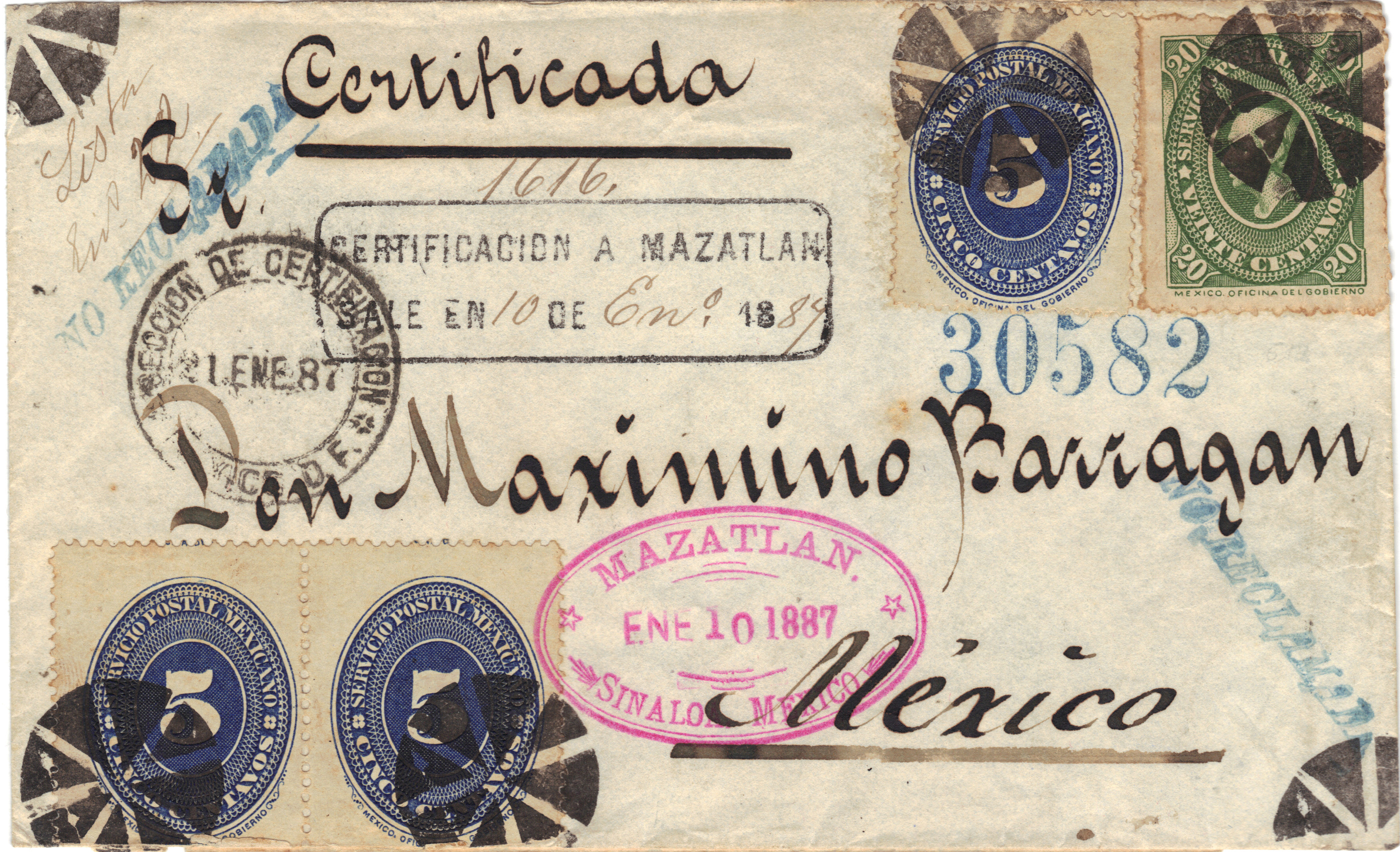
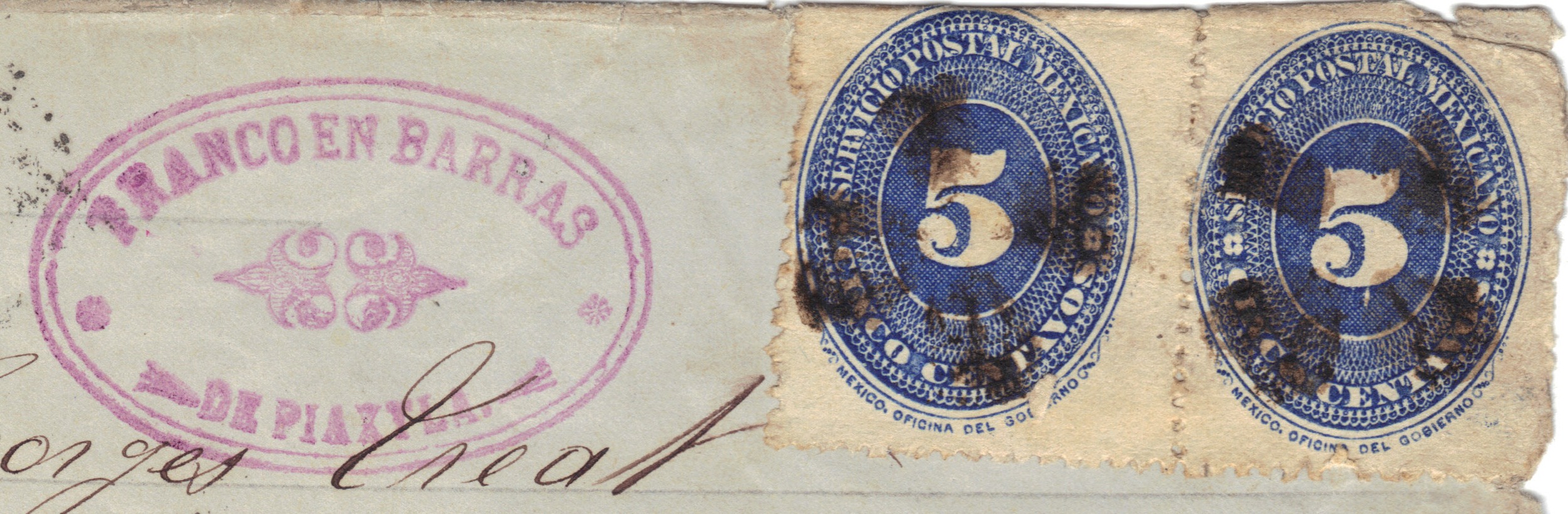
THE MULTIPLES
Many of the watermarked stamps in full panes appeared on the philatelic market after the issue was demonetized so some denominations with low catalogue value (e.g. 1c, 5c, 10c) exist this way and are not rare. However, some pretty scarce sheets and large multiples should be considered rarities:
- Any large multiple of the green lines ledger paper issue. Only 2 full sheets are known of the 5c and one of the 10c brown. To my knowledge, no full sheets of any other values have been found yet. The largest multiples I have seen of the others are a block of 25 (1c), a block of 18 (2c) and not even a pair of the 10c red.
- Large multiples of the 20c watermarked lilac, as no complete sheet seemed to have survived. All the large multiples that I have seen originated in one defective sheet that was separated some time ago, so each of those NH multiples may be unique.
- Some of the higher catalogue value stamps in sheets. For example, at least one or two of the watermarked 3c and 4c (5½ x 5½ ) full sheets exist.
THE LAST-MINUTE WATERMARKED 12c RED and 20c LILAC
A curious incident happened on March 11, 1895, less than a month before the Numerals were demonetized when the new issue Mulitas was launched on April 2, 1895.
For unknown reasons we can only speculate about, the watermarked 12c red was speedily printed and sold by the post office. Most likely this stamp was meant to provide philatelists with a thrill.
Some of this last-minute printing may be explained by the contents of a leaflet dated March 26, 1895, that I found in an early Mulita’s cover. It is in English addressed to foreign stamp dealers. It says “…Some fifteen days ago, there appeared for sale at the Post Office, in a very limited number certain 12 CENT SCARLET STAMPS….and the greater part being owned by me I will be able to attend to all your orders….Yours respectfully JV Revelo, Secretaría de Relaciones Exteriores, Mexico D.F.” Since Mr. Revelo gave his address to dealers as the Foreign Relations Ministry itself the issue was fully sanctioned by the government. Whether he profited due to his access or he was just a channel for the government to reach foreign dealers is anybody’s guess.
It is known that at least 50% of the 20,000 stamps printed did sell at the post office, and that the last 10,000 were due to a reprint made to satisfy philatelic demand. I have seen less than ten covers circulated in the mail, mostly from philatelists but not all, and a few up-rated registered postal cards to Europe. Many of these items were in the original Jay Bard’s collection at the time of his death.
As for the 20c lilac watermarked, a similar story may have happened.[5] Nicholas Follansbee is of the opinion that the 20c probably were made only for collectors and not sold over the counter. Since none are known postally used, he may be right. Since they were printed by the government it is clear to me that these are very collectable and cherished as other “unissued” stamps of other countries are.
This stamp is far scarcer than the 12c, so evidently fewer were made. The Scott catalogue prices of both stamps indicate a factor of rarity of 11x for the 20c lilac vs a vs the 12c red. In the absence of any records, and based on such indicator of market prices, we could guess than no more than 2,000 of the 20c lilac were printed, probably less. The fact that no complete panes of this stamp are known, and that the few large multiples in public auctions seem to come from a single defective sheet corroborates this hypothesis.
COMBINATIONS WITH OTHER ISSUES
Since this issue was valid in parallel with the Hidalgo Medallions, there are combinations with both on cover. They are colorful and difficult to come across. The combination with 1 peso blue Medallions is indeed very rare as only 30-40 covers/fronts exist with 1 peso stamps to begin with.
As for the subsequent issue, the Mulitas, only one non-philatelic cover is known to be legally used. This cover was originally sent with a 5c Numeral and penalized with 10c of Mulitas postage on arrival as double jeopardy (fig#13). The handful of Numerals postal cards with Mulitas added that exists are philatelic and paid the full postage in Mulitas stamps from origin so they do not count as a combination franking.
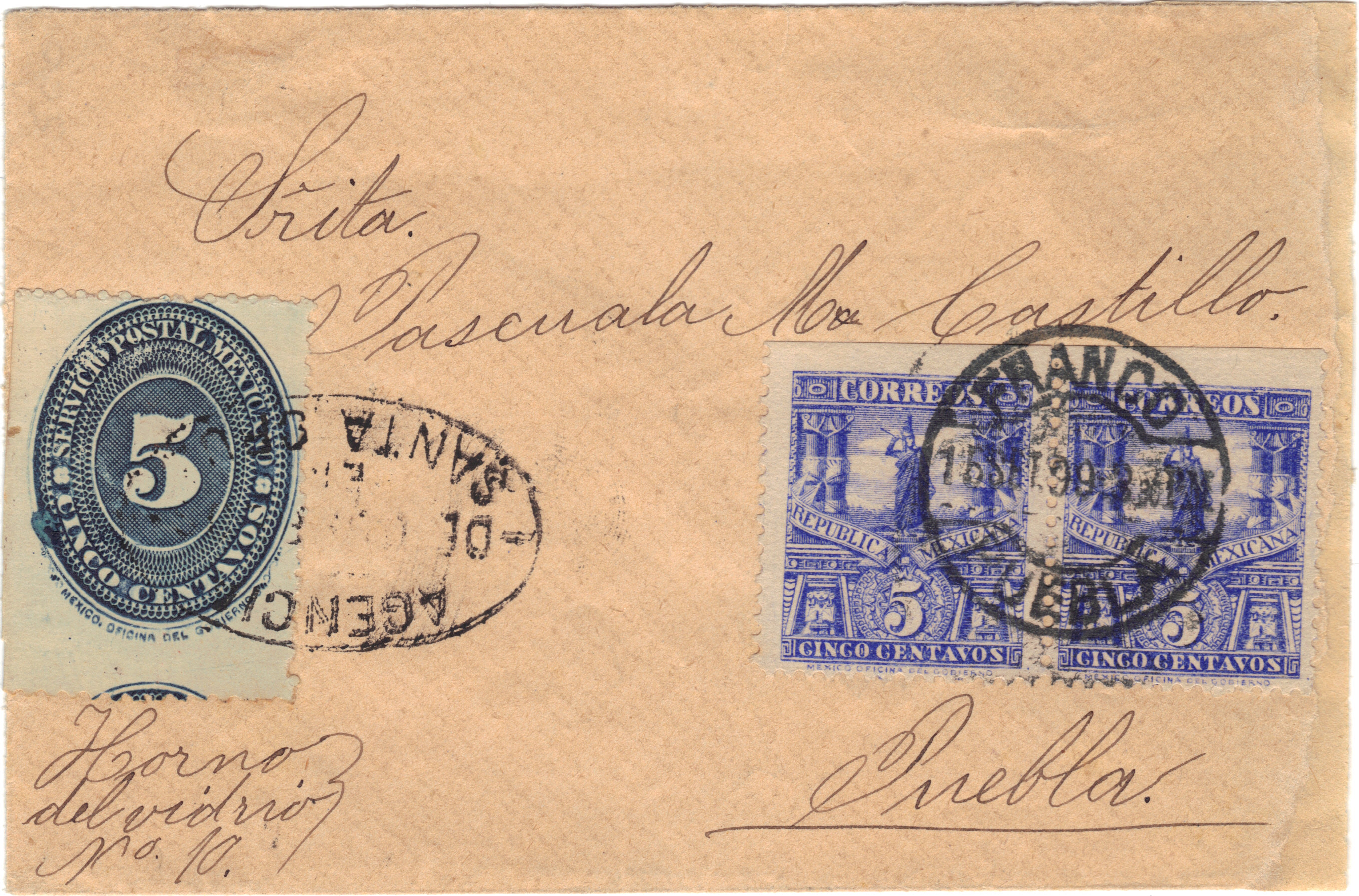
There are a few combinations used to uprate postal stationery covers from the 1874 issue. Since the 1874 postal stationery was not demonetized, they were legal.
The 10c Advertising Private Postal Stationery Covers
Postal stationery, preprinted stamps embossed on a card or a cover to pay for the postage was becoming popular in the world. A truly exceptional experiment never seen before anywhere else in the world was run during this period and deserves a comment here.
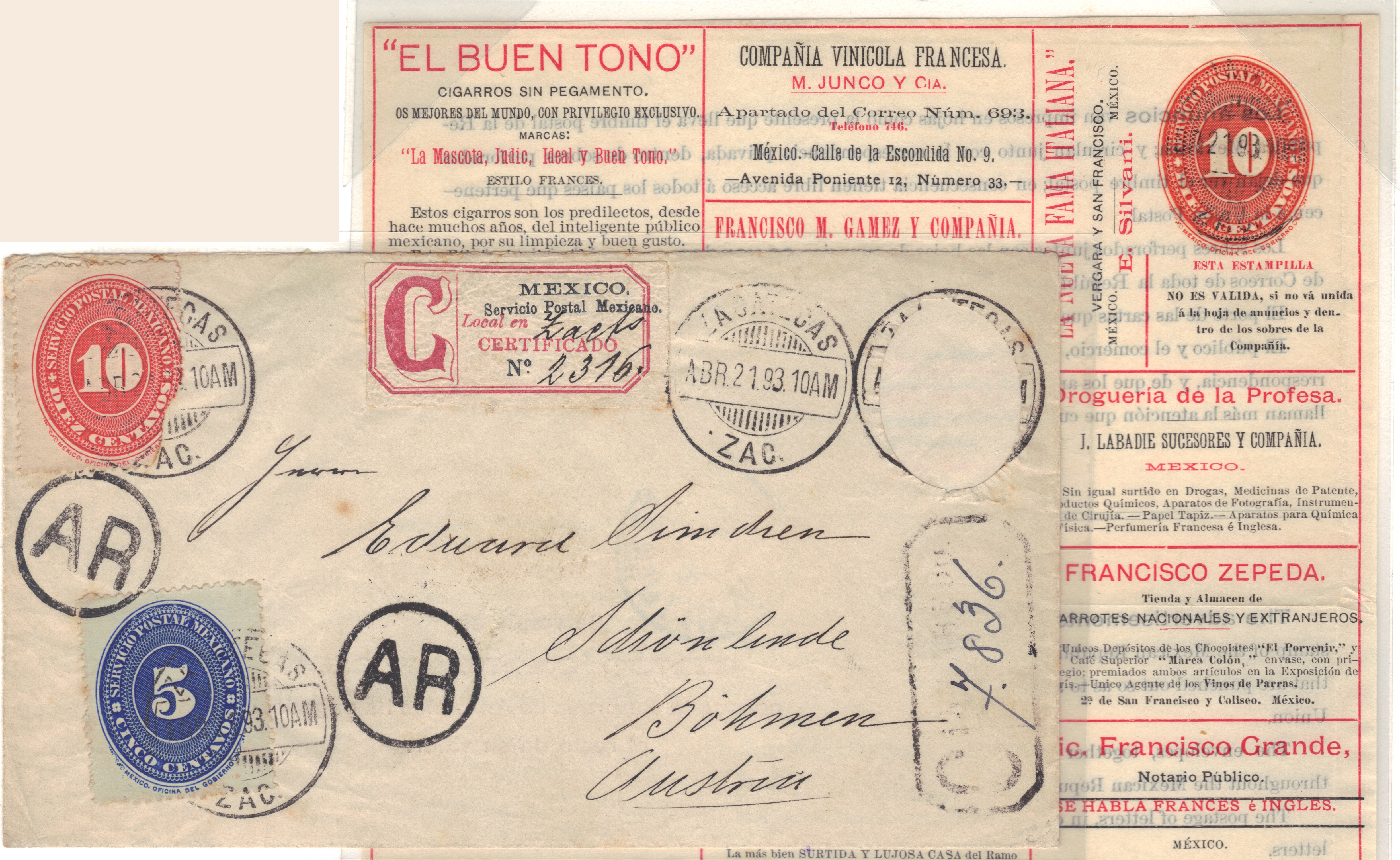
In late 1892 or 1893 the post office printed 10c postal stationery covers (to pay the regular domestic rate) with an open oval window at top right. Inside of the cover there was a leaflet with the 10c stamp design embossed at the top corner so that it could be seen and cancelled through the oval window. The buyer would only pay 5c (instead of 10c) provided he would attach to his letter the printed leaflet with ads from commercial companies. Those companies would subsidize the sender and pay the other 5c.
This experiment probably was not very successful as most of the existing copies are unused. Maybe 10 or so covers are known used, some even sent abroad and a couple uprated to pay certification. The used ones are all rare (fig# 14).
These covers were probably printed as private stationery for a particular advertising company handling the ads. Below the embossed stamp in the leaflet a legend reads “This stamp is not valid if not attached to the leaflet with the ads and inside of the company’s envelope.”
2c Colima "`Provisional": A Unique Case of a Quasi- Postal Fraud Benefiting the Post Ooffice
Moreover, an article in the contemporary philatelic press (American Journal of Philately, December 1893) asserts that Colima “Provisionals” were used as postage by people other than Mr, Escalante: “…(that) these stamps were sold at the Colima post office and prepaid mail matter not only in the interior but also to this country (US) is undoubted. On the day that is stamp was said to have been issued, we ourselves received a letter from Dr. J. W. Barstow, the well known Mexican coin collector, prepaid with these stamps.”[6]
These stamps have been disparaged by the philatelic press as a curiosity since they are, in effect, not a government issue but a private printing.
I think the Colima “Provisionals” are quite collectable as a unique type of quasi-postal fraud. They were clearly illegal as the stamps were illegally devalued. They are not postal frauds, as these stamps (when used on cover) did not deprive the post office from money. On the contrary, they brought the post office twice the rate (Escalante paid 2c each one, and used them as 1c).
Covers are clearly scarce and eminently collectable and exhibitable. After all, according to recent research published in Amexfil in 2008, one of the most coveted rarities in classic Mexico, the Tlacotalpam Provisional, was also a made up unauthorized stamp “issued” by a postal employee to cover postal theft.[7] Moreover, other postal frauds (such as the 1868 postal forgeries) are also very appreciated (particularly on covers) as privately printed unauthorized stamps that franked letters that travelled through the mail.
As Nick Follansbee pointed out to me there is indeed a vast difference between those two examples and the Colima “Provisionals.” The latter are much more common in singles and were created completely as philatelic product. However, they do all share some parallels in that they were illegal, created by postal employees and circulated as regular stamps in the mails without being assessed postal dues. As Langdon H. Longwell stated in his article in Mexicana in 1954, "they should be taken more seriously."[8]
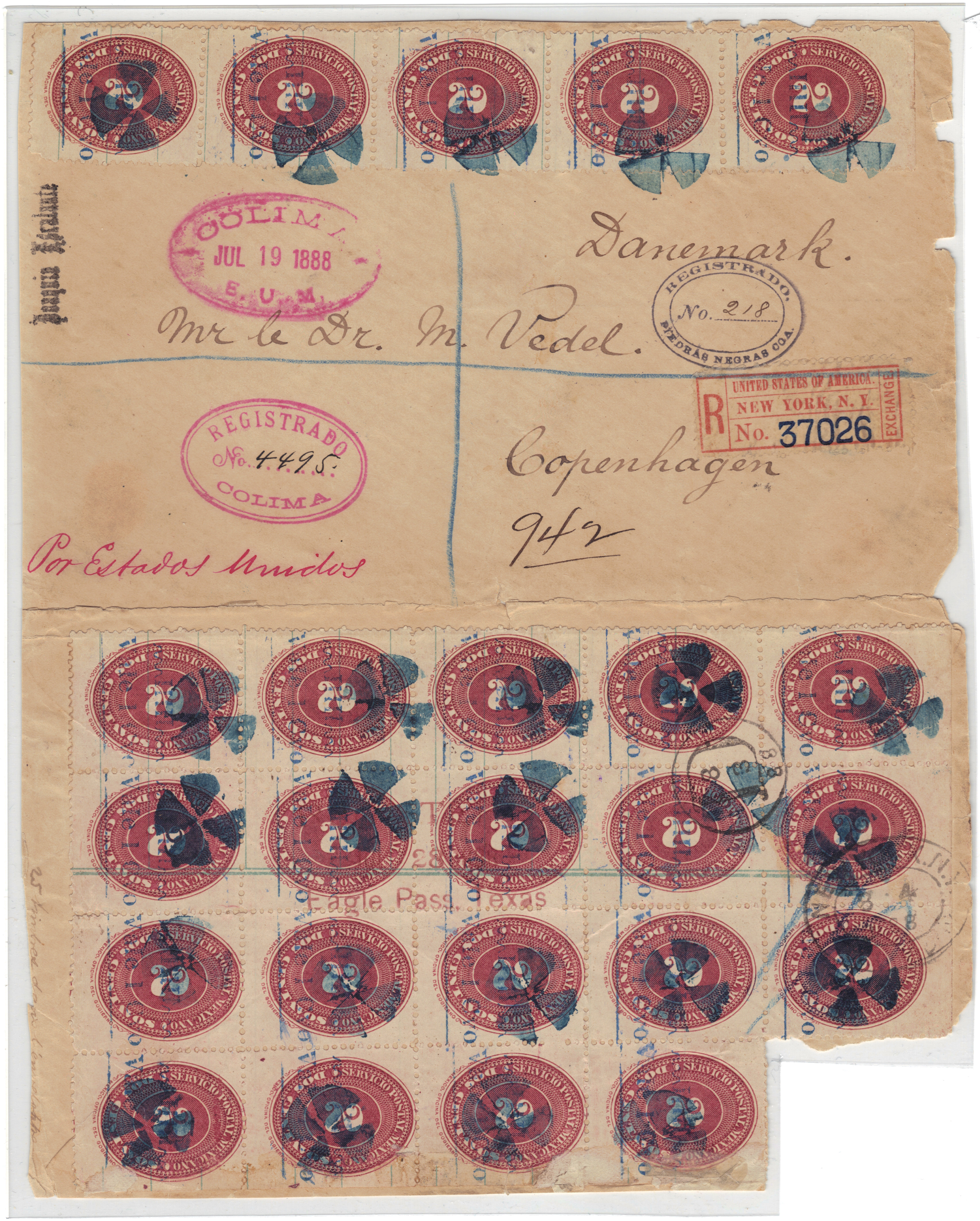
Probably the premier “Colima Provisional” cover is a letter to Copenhagen with the largest block of the 2c ledger lines known (19 stamps) (fig#16). Another exceptional item is a cover to Canada bearing the very rare 2c on ledger paper with genuine mixed perfs.
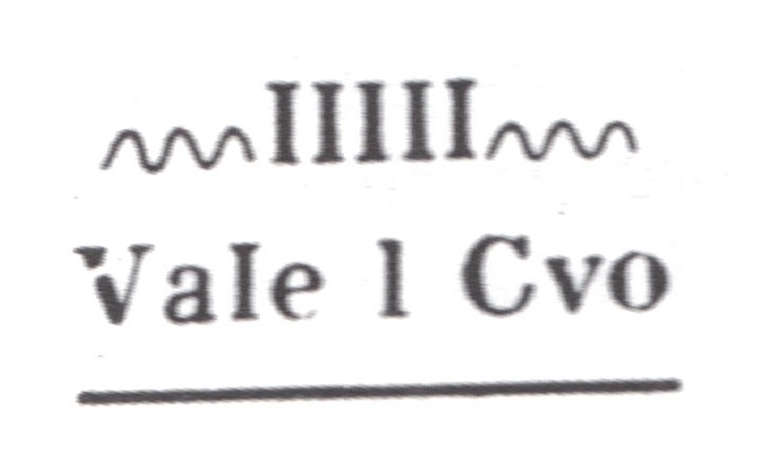
Curiously this overprint has been forged in black ink. This forgery has distinguishing characteristics in the typography of the letter “V” (left leg is cut in the “genuines”). Although it has long been believed that only violet overprints were “genuine,” there is at least one black overprint in a stamp attached to a letter to the USA which is probably “genuine” as well. It originated in the same city of Colima in the same time frame, went through the mail and looks identical to the violet “genuine” one with the “V” cut. Interestingly enough, there is no evidence it was actually sent by Escalante himself. So the rule of the black ink “fake” Colimas needs to be revised.
I want to thank my esteemed colleagues Nick Follansbee, Marc Gonzales, Jerry Winerman, Jaime Benavides, Janet Klug and Steve Rod for the feedback they gave me for this article and my life partner Glen Goodman who edited the first draft.
Endnotes
- The main sources of information are in Mexicana. They are: “The Issue of 1887 with Blue Lines” by Abraham Odfjell 1954 4th quarter, page 37; “Notes on the Large Numeral Issue” by E.W. Fager 4th quarter 1958, page 134; “Large Numerals of Mexico, 1887” by H.J. Almquist 3rd and 4th quarters 1982, pages 127 and 173; and “The Large Numerals Centavos of 1886-94” by David Angevine, 3rd quarter 2001, page 135. A very informative chapter about the Numerals issue is in Three Centuries of Philately in Mexico, "The 1886-1895 Numerals" a 2006 AMEXFIL publication, chapter 19, pages 221-230.
- The idea for the drawing originated in the fantastic Mulitas 1895-1898 Mail Transportation Issue of Mexico study by Karl H Schimmer and C.P. Bulak, A MEPSI publication, 1972.
- Rates in subsidized ships are very rare. I have seen only 2 covers with 5c regular mail and 2-3 one cent printed matter covers to Europe.
- Nicholas Follansbee, A Catalogue of the Stamps of Mexico 1856-1910.
- Nicholas Follansbee seems to believe both stamps were printed at the same time. A Catalogue of the Stamps of Mexico 1856-1910, page 112.
- Collin & Calman, American Journal of Philately, December 1893.
- Jose Vicente Pineda, Enrique Galina and Roberto Liera. Timbre Local de Tlacotalpan. Amexfil Magazine June 2008 #137, page 2,648. In this article the authors present a very plausible explanation for the Tlacotalpam “Provisional.” Their explanation is fully supported by official documents from 1856.
Apparently, this so-called “provisional” was not an officially sanctioned local, but instead part of a postal fraud scheme orchestrated by the Tlacotalpan post master Angel Fernando and his assistant Ignacio Crespo to cover for theft of the funds in that post office. The initials IMC in the stamp are most likely those of Mr.Crespo (I C). Legal documents presented in the article document that Mr. Fernando was sent to prison for a year after cash theft for $2,549 pesos was discovered in that office on November 25, 1856. Mr. Fernando fully confessed of “borrowing” the money because his mother was ill. Since the only Tlacotalpan “Provisional” cover in existence is dated a month earlier (October 20, 1856) and there are contemporary covers with regular stamps from the same office, this “provisional” stamp was clearly connected with the theft as part of this criminal scheme. Who knows, had the fraud not been discovered so soon, collectors might have been blessed with a few more “Tlacotalpans” for their collections! At the present time only 2 are recorded. One single and the above mentioned cover. - Langdon H. Longwell, “The Colima Provisional of 1888.” Mexicana, 4th quarter 1954, page 39.

 Facebook